The Technical Audit: Why Vaibhav Sooryavanshi’s Bat-Swing Faces a Structural Test in Manchester
A Rajasthan Royals teammate casts doubt on Vaibhav Sooryavanshi's style ahead of the Manchester T20I. Inside the technical analysis of his bat-swing.
Loading...

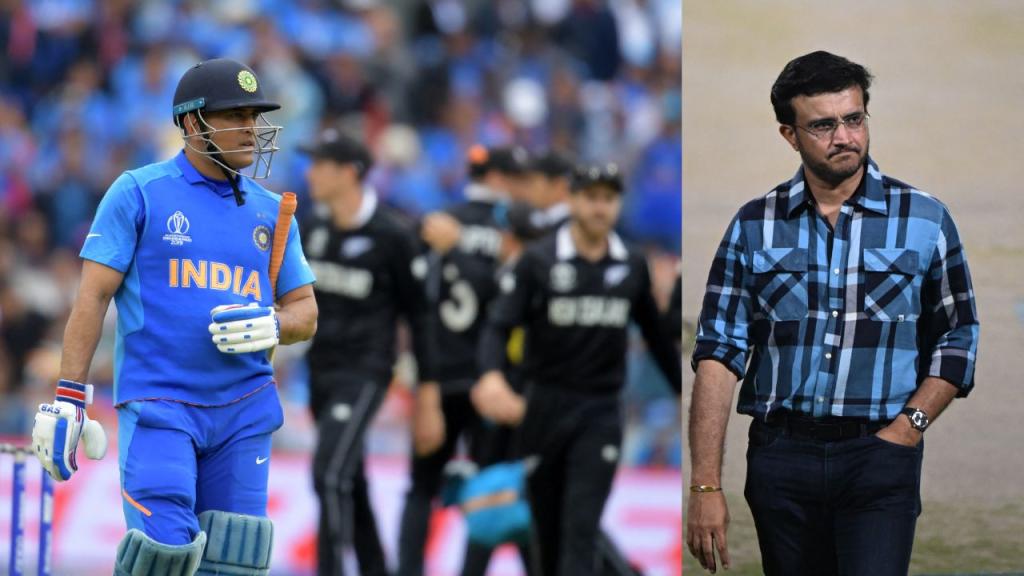
Sourav Ganguly rips MS Dhoni's conservative 2019 World Cup semi-final knock. The technical analysis of middle-over slowdown and friction on the pitch.
I was at the Eden Gardens commentary box last evening during the last overs of Match 56 and the mood became incredibly tension-filled when conversation shifted between the live game and the old middle-over strategy. The spectacle of watching Dhruv Jurel confront a defensive block during the 19th over versus Jasprit Bumrah trying to evade through a long-hard delivery, instead of clearing his leg in front, led to the discussion to be heated. Sourav Ganguly who was sitting a few feet away and a few feet away, was not shy about expressing his opinions. In his reflection on India's famous white-ball era, Ganguly brought back an old debate and offered an incisive critique on MS Dhoni's well-known, extremely conservative anchoring style that resulted in the controversial World Cup semi-final defeat in Manchester. World Cup semi-final exit in Manchester.
Table of contents [Show]
The core to Sourav Ganguly's criticism is based on the evolution of mechanical technology in T20 as well as modern ODI cricket. It focuses on the ways defensive batting triggers are ineffective against the best seam presentations and the pitch's friction.
In the semi-final of 2019 held at Old Trafford, the pitch had a high friction on the soil due to the overnight rainfall and damp top layer. When a bowler, such as Matt Henry hit a hard-length by using the cross-seam grip that held the ball in the ground, resulting in an unstable vertical trajectory. MS Dhoni's conventional technical set-up based on a stance with a deep crease with a heavy grip on the bottom of his hand was designed to reduce risk when bowling late in the direct line of vision.
But, on a rough surface that has lateral deviation this strategy blocks the chance to take advantage of the early powerplay exploits. In delaying the snap of his wrist and trying to force the ball through the gaps instead of hitting it directly through the line Dhoni was directly in the defensive line of New Zealand. Ganguly pointed out that when playing an heavy-ball method, staying in the crease, without an active forward push can increase the chance of hitting dots balls. This decision-making process directly led to stagnation, which meant that India achieved an average dot-ball rate of 48 percent throughout the middle innings and turned a shrewd chase into a mathematically impossible.
Ganguly's current assessment is logical instead of emotional. It is the "take it deep" strategy was the norm during the middle age of Indian cricket, has been made outdated with the demands of the tactical nature for 2026. 2026 season.
The Dot-Ball Pressure Aiming for a target on the wicket is a challenge that requires prompt stroke rotation. Dhoni's fifty off 72 balls did not provide enough energy for the bottom line of.
The Guard's Miscalculation In taking a long leg-stump defense to stop the ball that was short, Dhoni left his off-stump exposed to the ball's angled approach within the corridor of doubt, forcing him to play defensive dribbles.
The modern Shift: In the IPL 2026 the teams that employ an anchoring technique that is middle-over average an incredibly low 132.4 Strike Rate in comparison to 156.8 of teams using continuous aerial intentions.
Ganguly's argument is crystal clear the safety first cricket model has become a non-viable defense; it's an anchor for tactical purposes that pulls the entire batting line down.
The statistical difference between the anchoring style of the past and the contemporary dynamic framework is the reason why Ganguly continues to be critical of the Manchester model.
| Metric (Middle Overs 7-40) | The 2019 Manchester Template (Dhoni) | Modern 2026 Power-Exploitation Standard | Tactical Consequence |
|---|---|---|---|
| Dot-Ball Percentage | 48% | 26% | Squeezes Required Run Rate |
| Boundary Percentage | 8.3% | 18.5% | Fails to Disrupt Field Setups |
| Strike Rotation Rate | 44% | 68% | Allows Spinners to Control Length |
| Average Speed Faced | 138.4 kph | 144.2 kph | Hard Hands Cause Intent Stagnation |
It's not a personal dispute but a critique of the structure of a dated tactical philosophies. Sourav Ganguly's statements emphasize that current white-ball cricket doesn't have room to have a strike rate below 100 as an anchor regardless of previous significant milestones. This defeat in 2019 was a signal that Indian cricket was not paying attention at the right time, putting emotion instead of modern data indicators. Like the 2026 season shows all venues all the way from Raipur to Dharamshala Teams which survive are the ones that remove the dot-ball pocket completely. It is expected that Ganguly to use his platform to break down the tradition of conservative anchoring and push the present generation to tackle the the Corridor of Uncertainty starting with ball one.

A Rajasthan Royals teammate casts doubt on Vaibhav Sooryavanshi's style ahead of the Manchester T20I. Inside the technical analysis of his bat-swing.
Finland faces Portugal in the 1st T20I of the 2026 series at Kerava. Technical analysis of pitch friction, team squads, and expert match predictions.
Inside the VAR chaos: Learn how cricket's Snicko technology tracked a micro-touch to save Cristiano Ronaldo and Portugal at the 2026 World Cup.