The Technical Audit: Why Vaibhav Sooryavanshi’s Bat-Swing Faces a Structural Test in Manchester
A Rajasthan Royals teammate casts doubt on Vaibhav Sooryavanshi's style ahead of the Manchester T20I. Inside the technical analysis of his bat-swing.
Loading...

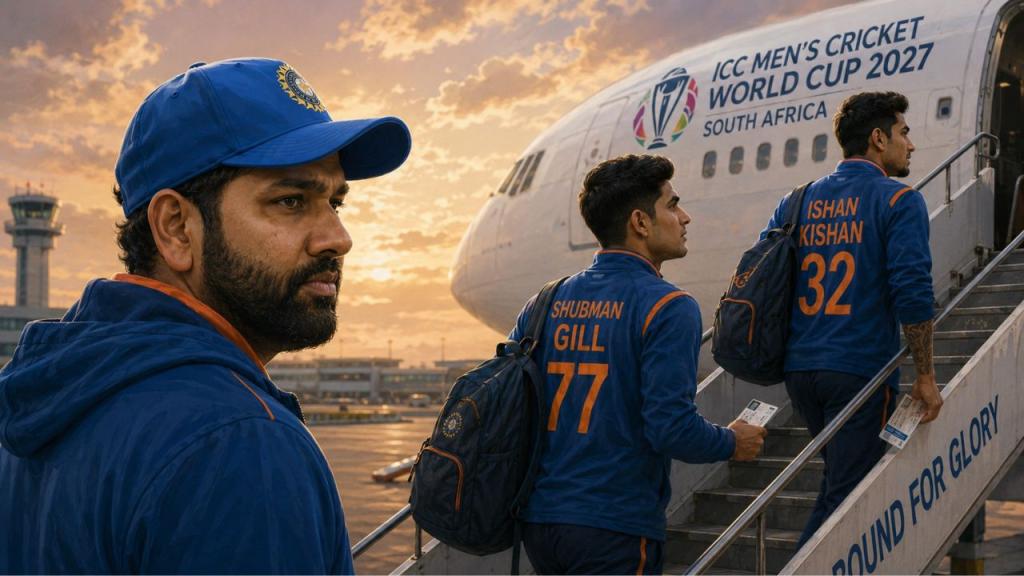
Which team will play for India in the event that Rohit Sharma does not make it to 2027's World Cup? Analysis of the technical aspects for Gill, Jaiswal, and Abhishek Sharma's combinations of tactical.
I stood on the border turf in the Arun Jaitley Stadium in New Delhi in the last overs of a training camp that was high-intensity as I watched the upcoming generation of India's white ball core perform repetitive exercises. The net in front of me was the Shubman Gill was battling Mohammed Siraj, who was pounding relentlessly on the ball with a hard-length using the cross-seam grip in the dark lighting. This brought to mind a vivid recall of Match 54 of the current IPL campaign. In that match, a short-lived technical error due to an old top-order anchor led to an utterly devastating dismissal in the first over which demonstrated how inflexible modern power-play metrics are. There is a growing sense the possibility that Rohit Sharma is likely to leave the team prior to 2027's World Cup, the selection committee is in the process of defining an after-Rohit's tactical future. It is a race to fill the post is no longer an issue for the future but rather an ongoing crisis of tactical importance.
Table of contents [Show]
In the process of replacing Rohit Sharma isn't just about the search for a player who is able to hit runs. It is about finding the right mechanical profile to be that is capable to perform instantaneous powerplay exploit. Sharma's history is founded upon his ability to thwart elite speed through neutralizing pitch friction using an instinctive forward press.
Top-quality pacers take the heavy ball at 145 km/h in the Corridor of Insanity and the ball performs differently based on the soil's composition. When playing on the real, slick decks to be expected from the 2027 hosts it is able to stay on its position with only very little variation. In order to take advantage of this in the first ten runs an opening batter of the present is not able to rely on defensive triggers which play later beneath the eye. Instead, they need an upper-hand, high-hand system that allows them to penetrate the seam of the ball, before the seam is able to interact with the pitch's surface.
The need for left-right combinations adds more complexity to this mathematical equation. Left-handed batsmen naturally alter release points of the bowler, causing them to change their direction over the stumps, interrupting their tempo. This is the reason the pairing with Yashasvi Jaiswal and Shubman Gill is highly favored. Jaiswal's low backlift and quick wrist-snap allows him to put a sting in quick deliveries without placing to a premature weight shift and reducing the chance that the ball will nip forward to meet the inside edge, a problem that plagues India's standard right-handed anchors for high-pressure knockouts.
The blueprint for India's strategic plan of 2027 top-order is divided into three distinct operating paths with each providing a distinct amount of anchor stability, and absolute speed.
The Alpha Pair (Jaiswal and Gill): This is the normal development. Shubman Gill, who is currently leading the IPL 2026 charts of runs with 616 runs, has an anchor structure that is classical. Yashasvi Jaiswal acts as the main disruptor and uses his desire to get rid of the infield before. The left-right dynamics intact, despite the ball one.
A Twin-Enforcer Schockwave (Abhishek Sharma and Jaiswal): An ultra-aggressive alternative, modeled after modern T20 dynamics. Abhishek Sharma has demonstrated an outstanding capability to hit at 175.5 during the Powerplay throughout his 2026 cycle. Utilizing two left-handed players that are able to trigger with high launch angles could force captains of opposing teams to eliminate their typical left-hand conventional and leg-spin match-ups right away.
The Redemption Continuity (Ishan Kishan & Gill): Following his spectacular debut in India's successful T20 World Cup campaign earlier this year -- where he hit 317 runs--- Ishan Kishan was returned to the 50-over game. Kishan's capability to play quick balls with high velocity is the perfect foil for Gill's technical skill against lateral movements that are standard.
The strategic choices are governed through data. The committee of selection is prioritizing fields-disruption measures over averages of raw data.
| Opening Contender | Batting Style | 2026 Season Runs | Powerplay Strike Rate | Dot-Ball Percentage |
|---|---|---|---|---|
| Shubman Gill | Right-Hand Bat | 616 | 138.4 | 34% |
| Yashasvi Jaiswal | Left-Hand Bat | 327 | 162.5 | 28% |
| Abhishek Sharma | Left-Hand Bat | 507 | 175.5 | 22% |
| Ishan Kishan | Left-Hand WKT | 490 | 154.2 | 31% |
The time for the traditional accumulation anchor on the top of the order has officially ended. No matter if Rohit Sharma is playing in 2027 or not the requirements of modern sports require that India is required to change its strategy towards an ongoing left-right explosive partnership. The selectors will decide to keep Yashasvi Jaiswal and Shubman Gill as the most reliable frontline pairing for the coming bilateral seasons. It's not a gamble on the horizon but a structural change to ensure that India's power-play model remains in the forefront of bowling developments across the globe. This transition is already taking place with the nets and data suggests the structure is durable.

A Rajasthan Royals teammate casts doubt on Vaibhav Sooryavanshi's style ahead of the Manchester T20I. Inside the technical analysis of his bat-swing.
Finland faces Portugal in the 1st T20I of the 2026 series at Kerava. Technical analysis of pitch friction, team squads, and expert match predictions.
Inside the VAR chaos: Learn how cricket's Snicko technology tracked a micro-touch to save Cristiano Ronaldo and Portugal at the 2026 World Cup.