The Technical Audit: Why Vaibhav Sooryavanshi’s Bat-Swing Faces a Structural Test in Manchester
A Rajasthan Royals teammate casts doubt on Vaibhav Sooryavanshi's style ahead of the Manchester T20I. Inside the technical analysis of his bat-swing.
Loading...

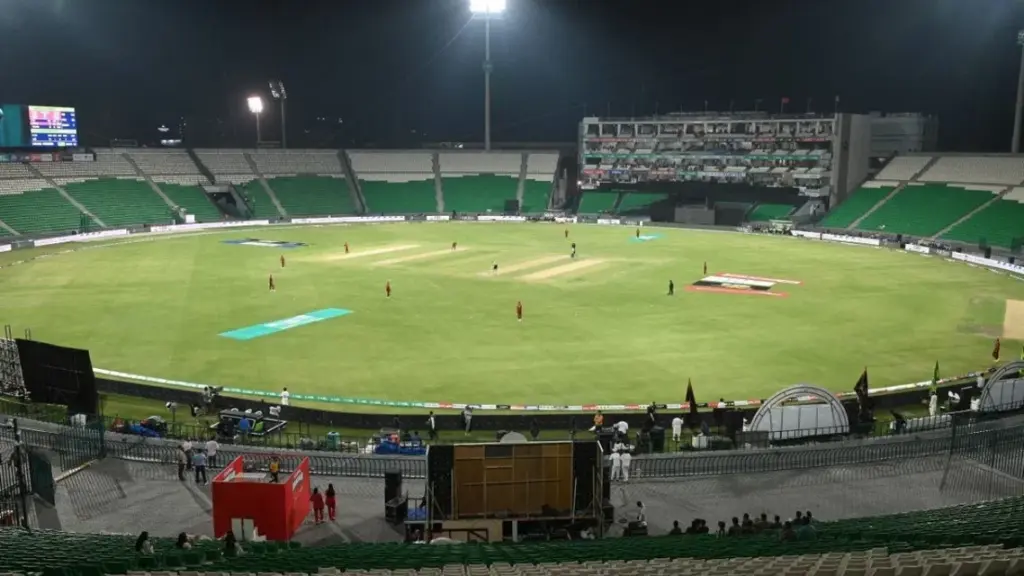
Accurate pitch and weather analysis for the PAK vs AUS 3rd ODI decider at Lahore. Discover why the low-bounce black clay will decide the series winne
I stood on the square at the Gaddafi Stadium in Lahore this afternoon during the pre-match warm-ups, and the thick, baking heat of the Punjab plains felt heavy. Looking closely at the center strip, it brought back an immediate memory from Tuesday’s second ODI at this very ground. During the 19th over of that match, Babar Azam looked entirely out of sync trying to force a forcing shot off a length ball from Adam Zampa, resulting in an under-edged chop onto his pads. The pitch had effectively slowed to a crawl. On this June afternoon, as the three-match series stands deadlocked at 1-1, the surface indicators for the decisive 3rd ODI are pointing toward another structural test of patience rather than an easy, free-flowing boundary exhibition.
Table of contents [Show]
The Gaddafi Stadium square relies on high-density black clay soil, a material that reacts intensely to extreme summer heat. With daytime temperatures pushing high limits ahead of the 4.30 PM local start, the top crust undergoes rapid solar compaction. This process triggers a massive increase in surface friction.
When a pacer like Shaheen Afridi or Nathan Ellis pounds the ball into a Hard-length—the 6-to-8 meter zone from the batting crease—the ball does not zip off the deck. Instead, the abrasive black clay "bites" the leather, causing the ball to hold and stick in the surface. This creates a highly deceptive two-paced vertical trajectory.
For the batsmen, this lack of standard skid means the ball consistently arrives later than the brain's visual trigger calculates. Attempting to hit through the line early in the innings is a technical trap. The cross-seam deliveries and slower-ball variations will remain highly effective in the Corridor of uncertainty, as the pitch friction effectively neutralizes raw velocity. Spinners, conversely, will exploit the dry dust pockets near the landing creases, finding significant grip to disrupt clean Strike rotation.
Australia won the toss and elected to bat first under the blazing afternoon sun, a deliberate tactical choice to avoid chasing on a track that systematically deteriorates.
The Powerplay Limitation: Without the morning moisture or evening dew to slick the surface, boundary hitting in the first ten overs is a premium constraint. Josh Inglis and Matt Short must build their innings through geometric placement rather than brute force.
The Slow Spin Suffocation: Pakistan’s tactical blueprint relies on choked lines. With Abrar Ahmed operating on an economy rate of 1.9 through his 10-over spell, the hosts are completely shutting down the scoring arcs, forcing Australia to manufacture pace against the turning ball.
The Attrition Counter: Australia’s middle-order engine room, anchored by Josh Inglis' gritty 65 off 71 balls, adjusted by playing deeper in the crease, choosing to work the ball into the deep pocket regions of long-on and mid-wicket.
The live numbers from the ongoing battle underline exactly how the surface is dictating the performance metrics of the key personnel.
| Player | Team | 3rd ODI Real-Time Metric | Tactical Impact |
|---|---|---|---|
| Shaheen Afridi | Pakistan | 3 Wickets (Econ 3.75) | Exploited Early Seam Friction |
| Abrar Ahmed | Pakistan | 2 Wickets (10-2-19-2) | Locked Down Middle-Over Scoring |
| Josh Inglis | Australia | 65 Runs (71 Balls) | Anchored the Innings Against Low Bounce |
| Shadab Khan | Pakistan | 2 Wickets (Econ 3.17) | Utilized Tacky Surface for Natural Variation |
This isn't a surface meant for modern power-play exploitation; it is a classical subcontinent war of attrition. Pakistan hold a massive structural advantage to secure the series victory on home soil. By successfully bowling out a second-string Australian lineup for a sub-200 total on a deteriorating track, their spinners have set a manageable target.
However, the chase will not be a walk in the park. Adam Zampa’s capability to extract lateral turn from the baked cracks will test the front-foot triggers of Babar Azam and Sahibzada Farhan. Expect a methodical, low-risk chase where Pakistan’s superior experience in dealing with low-bounce black clay outlasts the defensive lines of the Australian bowling unit.

A Rajasthan Royals teammate casts doubt on Vaibhav Sooryavanshi's style ahead of the Manchester T20I. Inside the technical analysis of his bat-swing.
Finland faces Portugal in the 1st T20I of the 2026 series at Kerava. Technical analysis of pitch friction, team squads, and expert match predictions.
Inside the VAR chaos: Learn how cricket's Snicko technology tracked a micro-touch to save Cristiano Ronaldo and Portugal at the 2026 World Cup.