The Technical Audit: Why Vaibhav Sooryavanshi’s Bat-Swing Faces a Structural Test in Manchester
A Rajasthan Royals teammate casts doubt on Vaibhav Sooryavanshi's style ahead of the Manchester T20I. Inside the technical analysis of his bat-swing.
Loading...

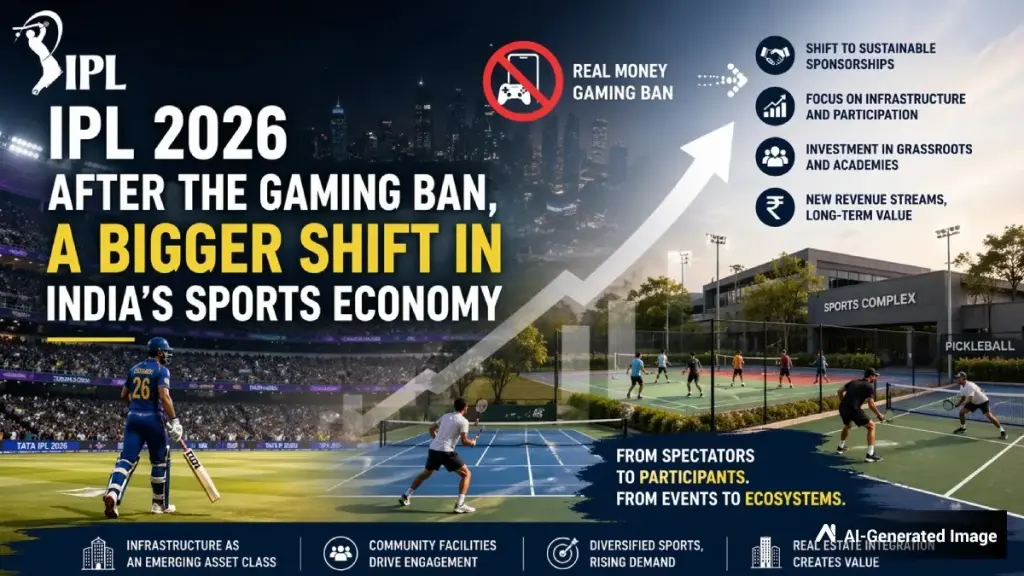
Discover how IPL 2026 is driving India's pivot to infrastructure-led sports growth following the 2025 online gaming ban. A thorough analysis of the emerging sport economy.
I've been watching the bowels of Indian sport business for many years The atmosphere of the IPL in 2026 has a distinct difference. We all know that the "Great Reset" triggered by the Promotion and Regulation of Online Gaming Act (PROGA) 2025 effectively shut the door on the real-money gambling (RMG) money-making machine, which was once the source of funding for IPL's marketing campaign. The results are evident in the present: instead of glitzy application downloads, the attention has been shifted towards tangible assets that last. India is moving away towards an "screen-first" spectator culture to an infrastructure-driven sports economy as well as IPL is the IPL is the key driver for this shift.
Table of contents [Show]
In the wake of the federal government's general ban on gaming with real money during November 2025 Many predicted that there would be a lack of sponsorship to be filled by the IPL in 2026. While the shock initially was huge--especially with big players like Dream11 as well as MPL switching to free-to-play models, the gap was soon filled with the more diverse mix of popular brands, and most importantly, institutions taking a look at sporting infrastructure.
The economy of RMG is changing. It is well-known that RMG was a very high-spend short-cycle division. Nowadays, I'm seeing franchises such as Royal Challengers Bengaluru and Mumbai Indians invest massively in high-performance centers that are open all year round as well as grassroots academies. It's not just about discovering an heir to Virat Kohli It's all about creating multi-sport hubs which can generate predictable and recurring income through participation and involvement in the community.
I think we're witnessing the emergence of sports infrastructure as an investment class for India. For the first time ever, the public is viewing the training and stadiums not just as "event-led" venues that stay empty for ten months of the year, but rather as socially-driven layers of monetization.
Multi-Sport Integration The latest advancements are shifting away from only cricket-based designs to more space-efficient sports such as badminton, tennis as well as the fast-growing sport of pickleball..
Urban Lifestyle Propositions Real real estate developers are positioning the sports facilities as central amenities - similar as parks or gyms--which contribute to a higher occupancy of properties as well as premium prices.
Steady Yields Contrary to rights for media, which are subject to fluctuation with each auction. Physical infrastructure can provide stable, low-risk returns via "pay-and-play" models and academy memberships.
I've looked at the change of revenue pillars in order to reveal how the game has changed following the 2025 gambling ban.
| Revenue Pillar | 2024 (Pre-Ban) | 2026 (Infrastructure-Led) |
|---|---|---|
| Primary Sponsor Category | Real-Money Gaming (Fantasy) | FMCG, FinTech & Infrastructure |
| Monetization Focus | Digital Engagement / App Traffic | Physical Participation / Coaching |
| Asset Type | Intellectual Property / Media Rights | Tangible Facilities / Academies |
| Fan Engagement | Speculative (Betting-lite) | Community-Driven (Active Play) |
From a professional perspective The tactical change from a professional analysis perspective, the tactical shift is obvious. We know that the IPL is worth more than the figure of 1.5 million increasing at around 12-13 percent each year. The fans, however, aren't more watching the full games The fact that I was able to observe is that a typical viewer is only consuming about 2 hours of live sports.
To stop this fragmented focus the franchises are creating physical contact points. If fans play at the LSG-branded academy, or plays on an LSG-branded Pacecourt artificial playing surface at an CSK facility, they're likely to stay committed to the brand all year. The "active participation" trend is fundamental, fueled by increased awareness about health issues and access to facilities. it's much more durable in comparison to digital-only participation previously.
It seems that, although we're in the middle to early phases of this change The direction is evident. The ban on gaming may be the trigger, however the trend towards infrastructure is indicative of an evolving market for sports. This is evident through the way the commercial and development hubs as well as developers have begun to consider the recreational infrastructure as an advantage in an increasingly competitive marketplace.
As the IPL 2026 advances, the true winners will not just be the teams that hold the trophy, but also the people who helped turn"PROGA shock "PROGA shock" into a involvement revolution. It's no longer the nation that watches cricket We know that India is now transforming into a country of athletes with a vast infrastructure of top-of-the-line facilities. This growth in infrastructure is the foundation that will shape the future of Indian sport.
What do you think could be the next sport after cricket that can benefit from this enormous increase in the local facility construction?

A Rajasthan Royals teammate casts doubt on Vaibhav Sooryavanshi's style ahead of the Manchester T20I. Inside the technical analysis of his bat-swing.
Finland faces Portugal in the 1st T20I of the 2026 series at Kerava. Technical analysis of pitch friction, team squads, and expert match predictions.
Inside the VAR chaos: Learn how cricket's Snicko technology tracked a micro-touch to save Cristiano Ronaldo and Portugal at the 2026 World Cup.