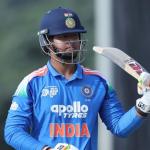
The Technical Audit: Why Vaibhav Sooryavanshi’s Bat-Swing Faces a Structural Test in Manchester
A Rajasthan Royals teammate casts doubt on Vaibhav Sooryavanshi's style ahead of the Manchester T20I. Inside the technical analysis of his bat-swing.
Loading...


Hardik Pandya's 2026 IPL Stats breakdown. Find out the exact price per game and for each wicket MI from his Rs16.35 Retention value of this season.
I was right in the middle of the dugout in my position at Wankhede Stadium during the final match of Mumbai Indians' ultimate league game in the match against Rajasthan Royals. The silence emanating from the stadium's pavilions was unbeatable and the only sound was the sound of seats being closed when the crowd walked towards the exits. I observed Hardik Pandya make his way back to his pavilion following being defeated by Jofra Archer's bounce after the hard, rigid delivery. His expulsion for 35 runs from 15 balls during that match put the final nail in the campaign which promise redemption, but ended in defeat. The fact that Mumbai Indians finishing their IPL 2026 league phase with eight loss in 10 matches under his guidance so the tactical and business issue has moved away from the field and into the ledger. The team was resigned for an impressive Rs16.35 million the 2026 statistics of Pandya are a stark representation of financial reality in the calculation of the price of each wicket and run that is scored.
Table of contents [Show]
Hardik Pandya's struggles through his entire IPL 2026 season was the result of physical and mechanical afflictions instead of a general decline in performance. In high-speed tournaments efficiency is determined by the speed of a downswing, and steady pelvic rotation. The battle that Pandya was fighting with constant back stiffness during the month of April and May changed his triggers to bat.
In order to counter modern heavy-ball quick-pitched techniques used by pacers of the opposition the aggressive middle order batter should establish a strong base in order for arms to stretch across the line. Due to physical limitations Pandya often found himself deep in the crease, using an upper-hand dominant grip causing his bat to cross the line. The mechanical fault was brutally visible on the rough black-clay surfaces found in the northern stadiums and on the friction surfaces with high soil in the home stadium. Instead of sliding onto the surface, it remained within the surface, causing players to make rapid aerial shots which hit those with larger pockets of boundary.
The mechanics of his bowling suffered the same structural decline. The release point of his bowl typically was an impressive 2.10 metres dropped just a bit to allow for a more vigorous follow-through. It made it difficult for him to locate the seams or to strike the Corridor of Uncertainty in a fast pace. He was bowling an average speed of 132-136 kmph instead of his maximum of 142 kmph his bowls did not have the required lateral deviation for a bat to be beaten when playing on flat tracks. This forced the player to let runs leak through the variations in cross seam.
A franchise that decides to allocate Rs16.35 crore of their salary for a single slot in its retaining system in which a player is required to fulfill the roles of two top experts. The last time the IPL was played, IPL 2026 Hardik Pandya managed to collect 206 runs while taking only four wickets over the 10 games he played.
In order to understand the financial value of this particular performance The contract's value needs to be divided evenly across the two responsibilities of his team or as a whole performance. If we partition the value of his retention equally among the bowling and batting units (Rs8.175 Crore per) The numbers show an unjust valuation model
Cost per Run At scores of 206 with an average 22.89 and an average striking percentage at 138.25, Mumbai Indians paid around Rs3,96,844 for each run with the bat of his captain.
Cost per Wicket After he managed just four wickets with an average economy rate of 10.5 on the Powerplay the price is an astonishing of Rs2,04,37,500 for each wicket.
The metrics show a serious strategic imbalance. When the primary all-rounder performs in a low strike-rotation efficiency and is unable to fulfill the third seamer's requirement, the captaincy burden is transferred entirely onto the specialist bowling core and he is able to overload Jasprit Bumrah in the process, and left the middle overs vulnerable to power-play abuse.
The stats of Pandya's double output against his immediate rivals tactically during his IPL 2026 season is a reason why Mumbai's performance stalled out at the game stage.
| Player (Team) | Retained Value | 2026 Season Runs | 2026 Season Wickets | Economy / Strike Rate |
|---|---|---|---|---|
| Hardik Pandya (MI) | Rs16.35 Crore | 206 Runs | 4 Wickets | 138.25 SR / 11.20 Econ |
| Axar Patel (DC) | Rs12.00 Crore | 242 Runs | 12 Wickets | 144.50 SR / 7.15 Econ |
| Sunil Narine (KKR) | Rs12.00 Crore | 310 Runs | 11 Wickets | 165.30 SR / 6.64 Econ |
| Pat Cummins (SRH) | Rs20.50 Crore | 115 Runs | 15 Wickets | 152.40 SR / 8.45 Econ |
The issue is not just a dip in the intention of the player; this is an overloaded structural system due to physical constraints and pressure from the tactical. Hardik Pandya's IPL 2026 season will be remembered as the lowest scoring return he has had from the cycle of 2021 and proves that an all-rounder can't survive just on their name alone if their bowling mechanics have been compromised.
In the midst of Mumbai Indians enter into the off-season, they will be reviewing their management structure, the information shows that the team is paying Rs3.9 Lakh per run and two crores per wicket is not a sustainable strategic and financial plan in a franchise aiming to win its sixth championship. It is likely that the management will enforce an extensive review of the bowling technique in the coming cycle since the current performance has officially put the team to a million dollars deficit.

A Rajasthan Royals teammate casts doubt on Vaibhav Sooryavanshi's style ahead of the Manchester T20I. Inside the technical analysis of his bat-swing.
Finland faces Portugal in the 1st T20I of the 2026 series at Kerava. Technical analysis of pitch friction, team squads, and expert match predictions.
Inside the VAR chaos: Learn how cricket's Snicko technology tracked a micro-touch to save Cristiano Ronaldo and Portugal at the 2026 World Cup.