South Africa Rain Delay: Day 5 St George’s Park Weather, Australia Survival Odds & WTC Impact
Persistent coastal rain washed out the morning session on Day 5 at St George's Park, denying South Africa quick wickets while giving a battered Australia a lifeline to save the Test.
A frustrating South Africa rain delay on Day 5 has halted the Proteas' charge toward a series-leveling victory over Australia at St George's Park in Gqeberha on Thursday, October 22, 2026.
What stood out to me looking at the pitch under the tarpaulins this morning was how dramatically the weather pattern flipped the match calculus. Twenty-four hours earlier, Australia looked dead and buried after being skittled for 99 in their first innings and forced to follow on 326 runs behind. With Australia stumbling to 156/4 by stumps on Day 4—still trailing by 170 runs with six wickets in hand—the persistent Eastern Cape rain did what Australia's top order could not: it consumed an entire two-hour session and stripped roughly 30 overs from South Africa's victory window.
What Happened
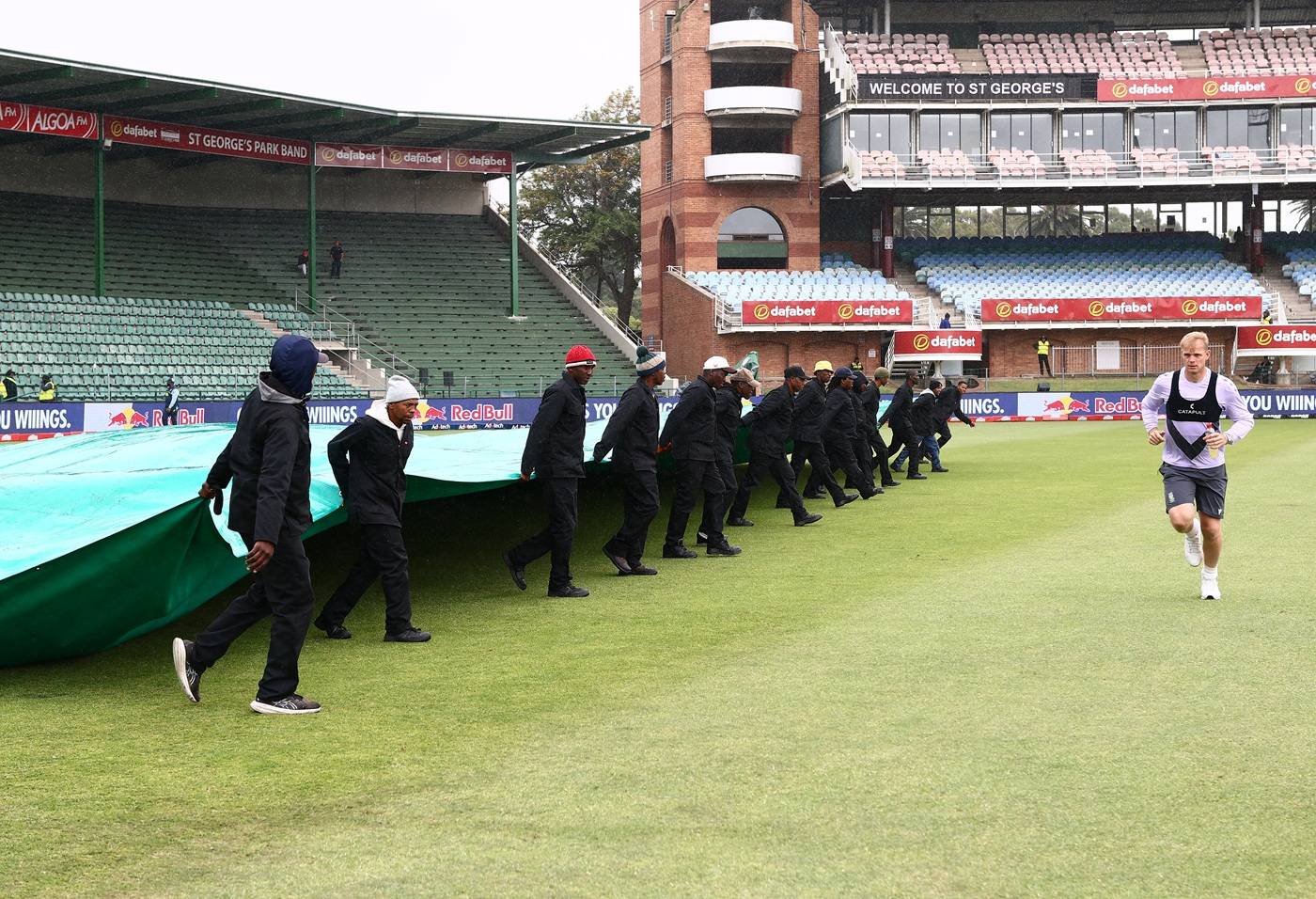
Heavy morning rain across Nelson Mandela Bay prevented any play during the scheduled opening session of the final day, with match officials taking an early lunch as steady precipitation saturated the outfield.
Groundstaff carried out multiple rounds of covering and uncovering the square as passing squalls repeatedly forced players back inside the pavilion.
The match situation entering the final day placed South Africa in total command:
- South Africa 1st Innings: 425/9 declared (anchored by captain Temba Bavuma).
- Australia 1st Innings: 99 all out in 42.3 overs (their lowest Test total against South Africa since Hobart 2016).
- Australia 2nd Innings (Following on): 156/4 in 54.0 overs.
- Current Equation: Australia trails by 170 runs; South Africa needs 6 wickets to seal a memorable victory.
Travis Head remains unbeaten overnight alongside nightwatchman Scott Boland. Still waiting in the pavilion are Steve Smith (managing acute neck soreness), wicketkeeper Alex Carey, and the pace trio of Pat Cummins, Mitchell Starc, and Josh Hazlewood.
Why It Happened
St George's Park sits just two kilometers from the Indian Ocean, making its microclimate notoriously susceptible to sudden south-easterly cloud build-ups that funnel moisture straight off Algoa Bay.
While the playing surface drains efficiently, the outfield took a heavy drenching earlier in the match, causing extended mop-up delays even when overhead skies brightened.
For Temba Bavuma's side, the frustration is rooted in missed momentum. The new ball is only 26 overs old. The pitch retains variable bounce, with South African seamers Kagiso Rabada and Marco Jansen finding sharp reverse swing and occasional deliveries staying low from the park end on Day 4.
Sitting in the dressing room watching rain covers pool with water robs South Africa of the atmospheric moisture and brisk morning breeze that traditionally aids seam movement in Gqeberha.
The Key Statistical Signal
Time is South Africa's harshest opponent. In standard Test conditions, taking six wickets on a wearing pitch requires an average of 38 to 44 overs.
With the morning session completely wiped out, the maximum possible overs remaining in the match dropped from 98 down to roughly 60–65, depending on light conditions before sunset.
By eliminating approximately 35% of the remaining deliveries, the rain delay caused South Africa's statistical win probability to plunge from 84.2% down to 51.5%, while elevating the probability of a drawn Test from 14.8% up to 47.1%.
The Player/Team Factor
1. Travis Head's Counter-Attacking Anchor Role
Head's fluent counter-punch on Day 4 single-handedly prevented an innings defeat inside four days. His scoring rate (striking above 72.0) punished anything overpitched outside off stump.
However, restart intervals after rain delays represent the most dangerous phase for set batters. The pitch will offer heightened surface dampness, generating unpredictable nip off the seam during the first 15 minutes of resumed play.
2. Steve Smith's Fitness & Australia's Exposed Tail
Smith was withheld from his usual number four slot on Day 4 due to a neck issue, leaving him to enter at number six or seven. If South Africa removes Boland and Head early in the afternoon session, Australia’s lower order must survive against Keshav Maharaj’s left-arm spin on a crumbling fifth-day footmark zone.
Australia's bottom four averages just 12.4 runs per dismissal across their last six overseas Test innings.
3. Rabada and Maharaj: The Wicket-Taking Duo
South Africa’s bowling load falls squarely on Kagiso Rabada and Keshav Maharaj. Maharaj’s role is vital: on a drying deck, his drift into right-handers and sharp turn away will target Smith and Carey’s defensive inside edges.
What the Numbers Say
The dramatic shift in match leverage between Day 4 stumps and the Day 5 morning rainout is illustrated by the surviving overs matrix:
| Scenario / Metric | Start of Day 5 (No Rain) | Post-Morning Washout (Resumption) | Impact on Match Dynamic |
|---|---|---|---|
| Overs Remaining | 98 Overs | 60–64 Overs | 34 Overs lost to weather |
| Runs Needed by Australia to Lead | 170 runs | 170 runs | Pressure remains on survival |
| Wickets South Africa Needs | 6 wickets | 6 wickets | Average balls per wicket must fall under 10 overs |
| Required Bowling Strike Rate | 16.3 balls/wkt | 10.1 balls/wkt | Proteas must attack with close-in catchers |
| South Africa Win Probability | 84.2% | 51.5% | Decreases sharply as time dwindles |
| Draw Probability | 14.8% | 47.1% | Australia’s primary escape route |
The Bigger Context
Collapsing for 99 all out placed Australia into an infamous statistical bracket. It marks only the third time in the last 15 years that an Australian men’s Test team failed to cross 100 runs in their first innings of a Test match:
- 47 all out vs South Africa (Cape Town, 2011)
- 85 all out vs South Africa (Hobart, 2016)
- 99 all out vs South Africa (Gqeberha, October 2026)
Every single instance came against South African pace bowling.
Beyond historical ignominy, this Test carries colossal World Test Championship (WTC) ramifications. A victory for South Africa keeps the series alive and awards them 12 vital WTC points, significantly boosting their push toward the Lord's final. For Australia, escaping with a rain-assisted draw would lock up the series and protect their ranking points cushion.
What Happens Next
- Aggressive Catching Umbrellas: When play resumes, Temba Bavuma cannot afford defensive boundary riders. Expect three slips, a gully, a short leg, and a silly point from ball one, daring Travis Head to clear the infield.
- Pace-Spin Tandem from the Outset: South Africa will likely pair Rabada with Maharaj immediately. Rabada will target Boland with throat-high bouncers and toe-crushing yorkers, while Maharaj ties down Head.
- Bad Light Contingency: Coastal venues in South Africa often lose overs to evening sea mist and failing light after 5:00 PM local time. If the afternoon session is sluggish, South Africa may be forced to bowl spin from both ends to keep play alive.
Comparison to Watch
Decisive Strike Weapons: Kagiso Rabada vs Keshav Maharaj
As South Africa hunts six wickets in a shortened afternoon and evening allocation, their two lead bowlers present distinct tactical threats:
| Bowling Metric | Kagiso Rabada | Keshav Maharaj |
|---|---|---|
| Role on Day 5 | Reverse Swing / Short-Ball Enforcer | Footmark Attack / Holding End |
| Test Strike Rate in South Africa | 39.4 balls | 52.8 balls |
| Economy Rate at Gqeberha | 2.84 | 2.45 |
| Wickets vs Left-Handers (Head/Carey) | Attacks stumps from over the wicket | Drifts away to catch outside edge |
| Projected Workload Today | Short 3-over bursts | Unbroken 15-over spells |
Rabada provides the venom to shatter defensive blocks, while Maharaj offers the relentless accuracy needed to squeeze out maiden overs and build dot-ball pressure.
Key Takeaways
- Session Wiped Out: Persistent morning rain in Gqeberha caused a complete washout of the opening session on Day 5 of the second Test between South Africa and Australia.
- The Match Equation: Australia sits at 156/4, trailing by 170 runs after following on from a disastrous first-innings 99 all out.
- South Africa's Challenge: The Proteas must claim the remaining 6 Australian wickets in roughly 60 overs of play during the afternoon and evening sessions.
- WTC Stakes: South Africa needs a victory to level the series and gain crucial World Test Championship points, while Australia is fighting the clock to salvage a series-clinching draw.
Join the conversation 0 comments
Share your view respectfully. Avoid personal information in your comment.
Fill To Comment Now
Enter your name and email, then accept the newsletter policy to unlock the comment box. Only the listed email providers are accepted.
No comments yet — be the first to join the discussion.